Outsourcing web development to Egypt: a practical guide for agencies and product teams
Egypt can be a strong fit for European and Gulf teams that need more development capacity — if you choose the partner and the working model carefully. Here’s how.
If you run a digital agency in Germany, a SaaS company in the Netherlands or a growing business in Dubai or Riyadh, you’ve probably met the same problem: more work than developers. Hiring locally is slow and expensive, freelancers come and go, and the big offshore firms want a long contract before they’ll talk to you.
Egypt sits in an interesting spot for teams like these. It isn’t the biggest outsourcing destination in Europe’s eyes — Eastern Europe still leads — but for the right kind of work it can be an excellent fit. We’re a tech-solutions company in Hurghada, working since 2018, and this is an honest guide to when it makes sense and how to do it well, whether you end up working with us or not.
Why teams look at Egypt
- Time zone. Cairo is one hour ahead of Berlin for most of the year, and close to the Gulf: level with or one hour behind Riyadh, and one to two hours behind Dubai. Your working day and ours overlap almost completely, so a quick call doesn’t need planning.
- Arabic and English. Egyptian teams build Arabic, right-to-left interfaces natively and work in English every day. For Gulf companies, that combination is hard to find elsewhere.
- Cost. Rates are lower than in Western Europe or the Gulf. Treat that as a bonus, not the reason — the cheapest offer is rarely the cheapest project.
- Travel. Direct flights connect Hurghada and Cairo with many European and Gulf cities, so meeting in person is realistic.
- Talent. Egypt has a large, young pool of software engineers, and many of them are used to working with clients abroad.
When outsourcing works — and when it doesn’t
It tends to work well for:
- Agencies with overflow: you sell and manage the client, a partner builds — often under your brand (white-label).
- Product teams that need a feature, an admin dashboard, an integration or an MVP built alongside their core team.
- Arabic versions of existing products, where right-to-left layout and real Arabic copy matter.
- Maintenance of web apps and sites your own team no longer has time for.
It tends to go wrong when:
- nobody on your side owns the product and makes decisions
- the scope is vague but the price must be fixed
- the partner is expected to read your mind instead of a written brief
- the cheapest bid wins, and quality is only checked at the end
Choose the right working model
Fixed scope, fixed price
Best for well-defined projects: a website, a landing-page system, a clearly specified feature. You know the cost up front. The trade-off is that every change goes through a change request, so you need a good brief.
Dedicated capacity
A developer or a small team works for you for an agreed share of their time, month by month. Best for ongoing products and for agencies with a steady flow of work. You set the priorities each week; the partner looks after the people.
White-label partnership
For agencies: the partner builds, you deliver under your name. Your client never meets the partner unless you want them to. Agree on confidentiality, branding and who talks to the client before the first project starts.
How to vet a partner
Portfolios are easy to dress up. These checks are harder to fake:
- Ask for live products, not mockups. Open them on your phone and click around. Do they load fast? Do they work in several languages? Ours are public: YallaTonight, Mr Egypt Trips and Noah Trips.
- Ask who will actually do the work. Talk to the people who will write your code, not only to the person selling it.
- Start with a paid pilot. A small, real task with a clear definition of done tells you more than any sales call.
- Watch how they communicate. Do they ask good questions? Do they write things down? Do you get updates without chasing?
- Look at their process. Version control, a staging environment, code review, testing on real devices and documented deployments.
Contracts, IP and data protection
Get the basics in writing from day one:
- Intellectual property: all code, designs and content made for you belong to you, and you receive the source code.
- Repositories and accounts: the code lives in your repository, hosting and domains are in your name, and you can remove anyone’s access at any time.
- Confidentiality: an NDA — and for white-label work, a clear no-contact and no-branding clause.
- Payment: milestones for fixed projects, monthly for dedicated capacity, and an agreed currency.
- Data protection: if the partner will handle personal data of EU users, you need a data processing agreement under the GDPR, and because Egypt has no EU adequacy decision, safeguards such as the EU’s standard contractual clauses. Egypt has its own Personal Data Protection Law, and Gulf countries have theirs too, such as Saudi Arabia’s Personal Data Protection Law. Check the details with your legal advisor — and prefer setups where the partner works with test data rather than live customer data.
Make the collaboration run smoothly
- One owner on each side, with the authority to decide.
- A written brief before work starts: screens, user stories, or at least a clear list.
- A shared board where every task has a status everyone can see.
- A short weekly demo of working software, not slides.
- Staging first: nothing goes live without your approval.
- Decisions in writing, so nothing gets lost between calls.
A good outsourcing partner feels like a team down the corridor, not a ticket queue in another country.
What a good first month looks like
- Kick-off: a call to walk through the product, the goals and the people involved, plus access to the repository, the staging environment and the tools you already use.
- A pilot task: something real but contained — a feature, a page template, an integration — with a written definition of done.
- Review together: look at the code and the result, not just a demo. Was it on time? Were questions asked early? Is the code readable?
- Decide: continue, adjust the model, or part ways having lost nothing but a small, paid task.
If the pilot goes well, the next step is usually a rough roadmap for the coming months and a steady rhythm of weekly demos. That rhythm matters more than any contract clause: it’s what keeps both sides honest about progress.
What 7Code brings
We’re an in-house team in Hurghada: developers, designers and a media-production unit under one roof. We build booking engines, ticketing platforms, PWAs, admin dashboards and multi-language sites with proper Arabic right-to-left support — plus the branding, photography and video around them. We work in English and Arabic, we’re happy to keep the code in your repository, and we like to start with a small pilot so both sides can see how the other works.
If that sounds like the partner you need, read more about outsourcing to 7Code, get a quick ballpark from our project estimator, or send us a brief. Curious how we work with tour companies? See what a booking site needs to sell.
More articles
All articles →
Restaurant marketing in Hurghada: get found on Google Maps and fill more tables
Tourists choose where to eat on their phone, often minutes before they sit down. Here’s how to make sure they find you, like what they see and walk in.
Hotel websites on the Red Sea: how to win more direct bookings
Many guests find your hotel on a booking platform, then check your own website before they decide. Here’s how to make that visit end in a direct booking.
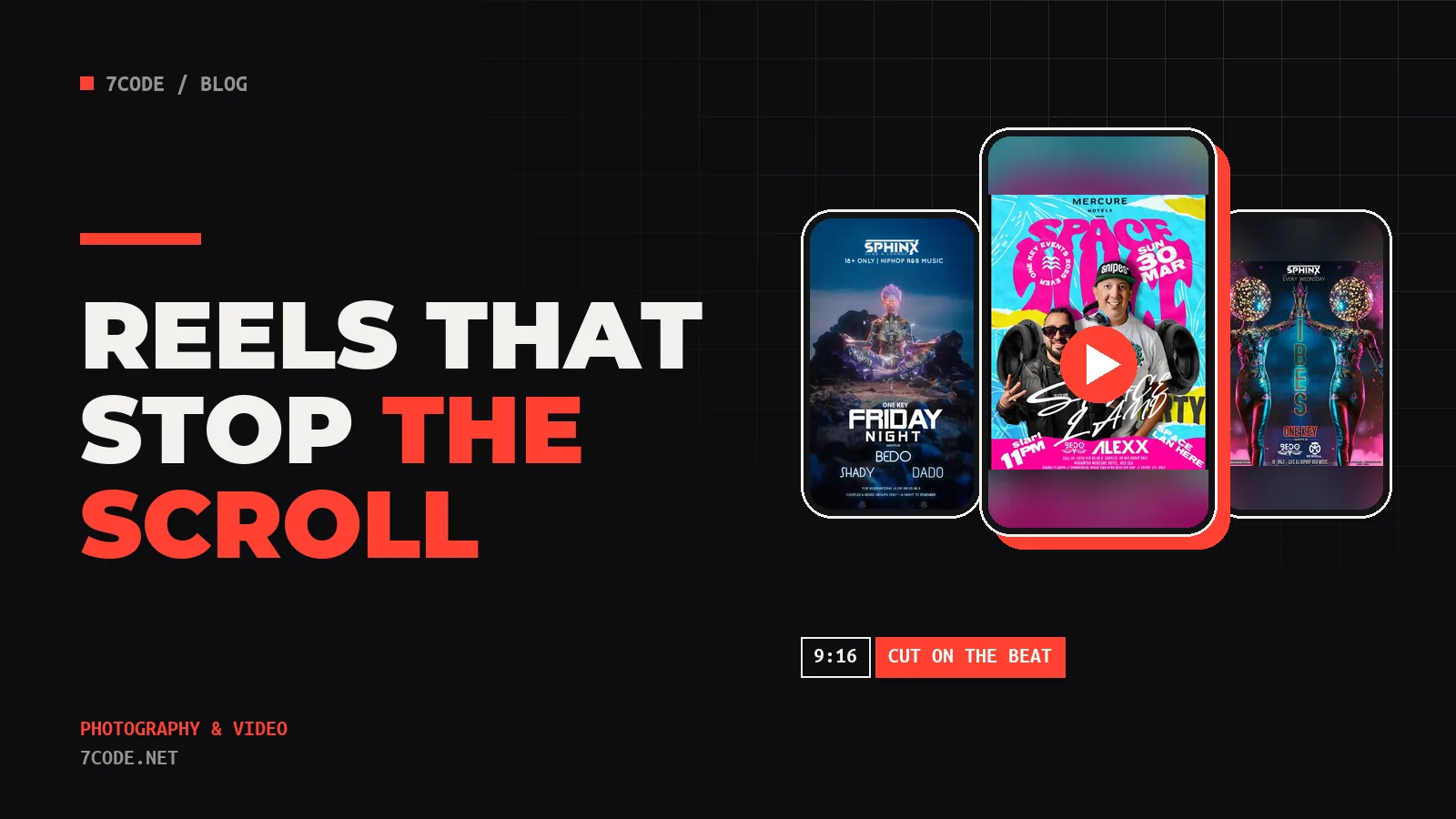
Reels for hotels & venues: content that stops the scroll
Practical shooting and editing tips for hotel, beach and nightlife reels — from the first second to the caption — based on the reels we film and edit in Hurghada.